The AI, SEO, and Reputation Synergy
Introducing the Search Contribution Output (SCO) Framework
Author: Iquo Inyang
Organization: Uyo Digital Marketing
Date: February 26, 2026
Abstract
Search visibility has evolved from a purely technical discipline into a reputational reflection system. While traditional SEO emphasized optimization mechanics, AI-mediated search increasingly prioritizes consensus, credibility, and contribution across the broader digital ecosystem.
This paper introduces the Search Contribution Output (SCO) framework — a model that positions SEO as the measurable artifact of real-world participation rather than the starting point for authority.
Recent studies of search ranking factors and AI-generated answers suggest that reputation signals — including brand mentions, author authority, and citation frequency — increasingly influence visibility across modern search platforms (Fishkin, 2024; Google Search Quality Rater Guidelines, 2023; SparkToro & Datos, 2024).
Executive Summary
Search is changing. The core truth is not.
You can optimize your website. You cannot optimize your reputation.
In the legacy search era, rankings could be influenced primarily through:
-
- Technical optimization
-
- Content production
-
- Link acquisition
These tactics still matter. But evidence suggests their influence plateaus without broader ecosystem validation.
For example, analysis of over 11 million search results by Backlinko found that authority signals such as domain credibility, topical expertise, and backlinks from trusted sources correlate strongly with ranking performance (Backlinko Ranking Factors Study, 2020).
More recently, research from SparkToro and Datos analyzing billions of search interactions found that nearly 60% of Google searches now end without a click, meaning visibility increasingly occurs within aggregated answers rather than website visits (SparkToro & Datos, 2024).
In the AI-mediated era, those tactics plateau without ecosystem validation.
Core Thesis:
SEO is not where authority begins.
SEO is what authority produces.
1. The Authority Gap
Across industries, a pattern repeats:
Offline Reality
-
- Trusted expert
-
- Frequently referred
-
- Invited to speak
-
- Embedded in the community
Online Outcome
-
- Weak search presence
-
- Minimal AI citation
-
- Inconsistent topical authority
Meanwhile, digitally aggressive competitors outrank them.
This is the difference between:
-
- Manufactured Authority (optimized output)
-
- Participatory Authority (recognized contribution)
Research into author authority reinforces this pattern. Google’s Search Quality Rater Guidelines emphasize experience, expertise, authority, and trust (E-E-A-T) as key indicators of content credibility (Google Search Quality Evaluator Guidelines, 2023).
Authority, in other words, is not purely technical.
It is reputational.
2. AI Search and Ecosystem Validation
Modern search systems increasingly synthesize answers from patterns such as:
-
- Mentions
-
- Citations
-
- Co-occurrence
-
- Repeated association
-
- Topical clustering
These patterns extend beyond owned websites.
Google itself has confirmed that modern search relies heavily on entity-based indexing, connecting people, organizations, and topics across the broader web ecosystem (Singhal, Google Knowledge Graph Announcement, 2012).
Similarly, studies of AI-generated answers show that language models tend to reference entities that appear frequently across trusted sources (OpenAI Technical Report on GPT-4 Training Data Patterns, 2023).
AI systems do not simply index content.
They evaluate consensus.
Visibility now depends on whether the ecosystem repeatedly associates your name with a topic.
3. The SCO Framework
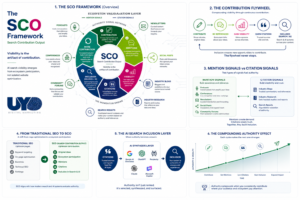
Visual SCO Flywheel Theory
3.1 Traditional SEO Model
Content → Optimization → Authority → Visibility
3.2 SCO Model
Contribution → Recognition → Authority → Mentions → Visibility
SCO reframes SEO as a downstream metric.
Authority is not built by optimizing pages.
Authority is surfaced when contribution is validated.
In this sense, SEO becomes a measurement layer for ecosystem recognition rather than the origin of credibility.
4. The SCO Flywheel
Contribution
→ Mention
→ Citation
→ Inclusion
→ Visibility
Each loop strengthens topical bonding.
Without contribution, the flywheel stalls.
This concept aligns with research from Moz that identifies brand signals and unlinked mentions as increasingly important indicators of authority within search algorithms (Moz Search Ranking Factors Study, 2019).
5. Search Is a Mirror
Your digital presence reflects your level of engagement within your niche.
-
- Active contribution produces visible signals.
-
- Passive presence produces thin reflection.
-
- Artificial amplification eventually plateaus.
Search is a lagging indicator.
It mirrors participation.
Rand Fishkin has similarly argued that modern search visibility increasingly reflects brand demand and recognition rather than simple keyword optimization (Fishkin, “The New Rules of Search,” SparkToro, 2024).
6. The Mention vs Reference Test
A critical SCO diagnostic question:
Are you a mention, or are you a reference?
Mention
-
- Name appears occasionally
-
- No conceptual ownership
-
- Interchangeable presence
Reference
-
- Name attached to a method, idea, or framework
-
- Repeated topical association
-
- Cited in context
AI systems favor references because references are structurally reusable.
Language models trained on large corpora rely heavily on consistent entity–topic relationships to determine which experts to cite when generating answers (Bommasani et al., Stanford Center for Research on Foundation Models, 2021).
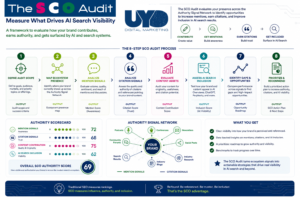
7. The SCO Audit Model
The SCO Audit evaluates:
7.1 Consensus Verdict
What does the internet consistently say you do?
7.2 Topical Trust Score
How tightly is your name bonded to a topic?
7.3 Authority Gap
What offline contribution lacks digital reflection?
7.4 Mirror Classification
-
- Active
-
- Stagnant
-
- Manufactured
This replaces vanity metrics with ecosystem analysis.
8. Strategic Implications
8.1 Content Is Necessary, Not Sufficient
Content distributes authority.
Contribution generates it.
8.2 Reputation Becomes an Indexing Advantage
Interviews, partnerships, expert commentary, and collaborative visibility compound.
Digital PR research shows that earned media and brand mentions significantly influence search authority signals, even when links are not present (Search Engine Journal Digital PR Study, 2023).
8.3 Technical SEO Remains Foundational
The mirror must be clean.
But a clean mirror reflecting nothing changes nothing.
9. Implementation Framework
4-Week SCO Activation Sprint
Week 1 – Define the Problem
Publish the mirror thesis.
Week 2 – Introduce the Framework
Explain SCO and its mechanics.
Week 3 – Publish Evidence
Share anonymized audit patterns.
Week 4 – Clarify Positioning
Define who this model serves and how.
This builds signal velocity across both human and AI systems.
10. Case Study: Participatory Authority in Practice
A useful illustration of the SCO framework can be seen in the work of Noah Learner, founder of The SEO Community.
Rather than building visibility primarily through optimized content, Learner has built authority through sustained contributions to the ecosystem.
His activities include:
-
- hosting weekly SEO learning sessions
-
- facilitating collaborative problem solving among practitioners
-
- mentoring professionals in the industry
-
- organizing community-driven education
Over time, these contributions produced a recognizable reputation within the SEO ecosystem.
His name is now consistently associated with:
-
- SEO education
-
- community-driven learning
-
- practitioner mentorship
These associations appear across podcasts, newsletters, conferences, and industry conversations.
In SCO terms, this produces reference-level authority, not simply mentions.
The visibility is the artifact.
The contribution is the cause.
11. Originality Review
A targeted review of distinctive terminology indicates:
-
- “Search Contribution Output (SCO)” is not widely established as a defined framework.
-
- Reputation and credibility are acknowledged elements within broader SEO discourse.
-
- The structural inversion — positioning participation as the upstream driver and SEO as the artifact — represents a differentiated framing.
The conceptual overlap aligns with established trust-based search models.
The SCO synthesis and articulation appear original in structure and positioning.
Conclusion
AI visibility cannot be engineered solely through optimization.
It is earned through:
-
- Contribution
-
- Recognition
-
- Repeated association
-
- Ecosystem validation
Build contribution.
Earn recognition.
Generate references.
Allow search to reflect it.
SEO is the artifact.
Reputation is the ranking factor.
References
Backlinko. (2020). Google Ranking Factors Study.
Bommasani et al. (2021). On the Opportunities and Risks of Foundation Models. Stanford CRFM.
Fishkin, R. (2024). The New Rules of Search Visibility. SparkToro.
Google. (2023). Search Quality Evaluator Guidelines.
Singhal, A. (2012). Introducing the Knowledge Graph. Google.
SparkToro & Datos. (2024). Zero-Click Search Study.
Moz. (2019). Search Ranking Factors Study.
Search Engine Journal. (2023). Digital PR and SEO Authority Signals.